2026 · 11 · 27 · Day 82 · Building
Have you gone to the gym lately?
I might regret this later, but here goes: I'm giving away a 3-month free trial of Fernsage to people who sign up for my writing meetup in December. If you have a draft you keep putting off, let's hang out and write! I'll offer my feedback on your draft if you want.

Have you gone to the gym lately?
When I set out to build Fernsage, I wanted an app to help me become wiser. Despite my years of experience as a marketer, writer, and founder, I felt I wasn’t retaining my knowledge. Nothing was compounding. I felt stupid. I thought perhaps what I had to do was to take more notes and revise my notes more often, which was how I did well in school. So I made a notes app that resurfaces an old note every day.
I used the app every day for about five months. I like the practice of commonplacing or hypomnēmata, where you revisit something you copied down previously. So, I made an app for that valuable practice and added all sorts of interesting automation that a physical notebook couldn't do, like emailing you a note every morning. I genuinely thought it was a valuable product for others too. After putting it off for weeks, I finally plucked up the courage to share it in r/commonplacebook, where I had been sharing my commonplacing journey for months. It bombed, and I deleted my post about two hours later.
People hated me. They didn’t even dislike the product. I doubt they even went to the website. They just hated that yet another person (me) shared yet another app in their niche community.
But I was glad that happened. Without it, I might not have forced myself to look at Fernsage more honestly. That's when I realized I was using Fernsage every day because I made it. Not because I found it useful. I fooled myself.
Oddly, I actually felt relieved. I could finally stop (subconsciously) pretending this thing that I made was great and move on to the next thing. But I wanted to answer a question first: Why hadn't I found Fernsage to be valuable?
I found my answer in parenting.
Getting in the parenting reps
When my kids got HFMD and were home for 10 days, I practiced hypomnēmata to keep myself sane. I read Charlie Munger's advice to avoid feeling sorry for myself. I read Clayton Christensen's reminder to prioritize long-term stuff (like raising good children) over short-term gains (like working hard to get a raise). It was helpful to remind myself of all that when I was tired, grumpy, and couldn't think straight.
But what I still had to do was to take action—or get in the reps. Whenever I started complaining that life was unfair and asking why it had to be my kids, I made myself pause and say in my head, "Complaining will only make me feel more miserable. Let's try and find something good from this." Of course, I found nothing good when I tried that for the first time. Nor the second time, nor the tenth time. It was only when I reflected back on the period that I noticed I was becoming more understanding and patient because I had to deal with meltdowns day in and day out.
No amount of reading, note taking, and revising my notes will make me a great parent if I don’t actually try to be one. I can read about being patient all day. I can read about how our time with our children is finite and we are always losing them. I can even write about that. But what I really need to do is to practice regulating my emotions and explaining myself calmly to my children whenever they melt down, over and over and over again. Yes, over and over and over again. Case in point: After writing What bedtime taught me about patience, I snapped at my son for stalling bedtime the following night.
Looking at how I parent made me realize why Fernsage as commonplace software wasn't valuable to me. It wasn’t that I was forgetting my notes and needed an app to remind me. It was that what I have been working on cannot be learned from taking notes and reading alone.
Once or twice is not enough
Once that became clear to me, I started seeing the same pattern in other areas of my life, say, startups.
I have read and heard people talk about not overbuilding your MVP, especially when you have no customers yet. It feels so obvious until you are actually building it. Suddenly, everything feels non-negotiable and the scope creeps. I know it’s an MVP, but it really, really needs these 10 things.
No, it doesn’t.
This was first drilled into me when my former cofounder, SK, built the first version of Pebblely. It was just a Python script, a database to store images, and an interface for users to sign up, run that script, and see their images. I wasn’t sure about that minimum viable product because it was really minimal. But it worked. We hit our revenue target for the first month within the first day. As Pebblely gained traction, we gradually improved it. Many features that I thought were must-haves at launch were only nice-to-haves.

But it's hard to internalize it from just a single experience. Overbuilding looks different for every product.
Despite that Pebblely experience, I overbuilt Fernsage before I had any customers. When using Claude Code (Opus 5.5) to build Fernsage, I noticed it kept wanting to build something comprehensive and thorough, even when it was unnecessary. For instance, it wanted to add multiple measures to prevent bad actors from creating Fernsage sites for spam. Nobody was even visiting Fernsage yet, let alone entering a credit card to publish a site. But because it felt easy to build the guardrails with Claude Code and they felt like the right things to have, I spent several days adding and checking them. I should have launched earlier.
I relearned the lesson the hard way by trying, failing, and then realizing I had learned this before. But that is the way.
I'm not stupid. I just haven’t practiced enough. I haven’t gotten in enough reps.
More than you think
That lesson made me realize that I need to do far more than I think is necessary: Practice being patient, build and launch more products, write more often.
Let's take writing, for example. In September, I committed to publishing daily on my website. I have long wanted to be a writer, and I figured I wasn’t writing enough. I started writing a short article every day and thought it was sufficient because an article a day felt hard enough. Then I discovered Ryan Holiday has three to four months' worth of daily articles ready to be published at any time. Mine were rookie numbers! I needed to write a lot more. Like A LOT MORE. Since then, I have written more daily and built up a buffer of three weeks of daily articles.
I caught up with SK last week, and he asked the hard question, as he always does: Has my writing actually improved?
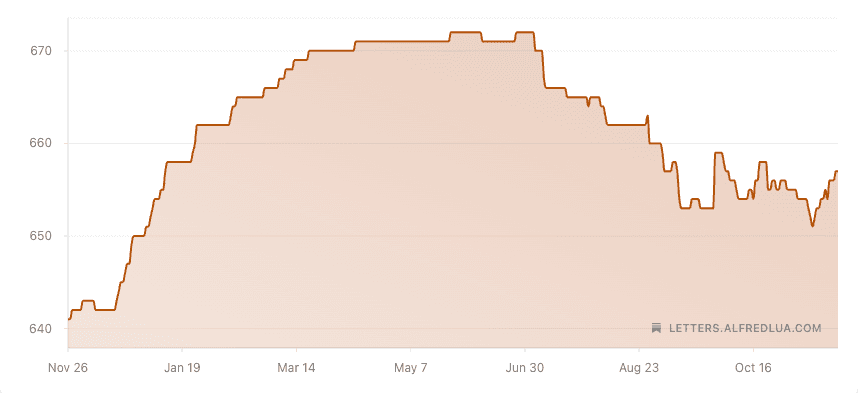
If we judge it by just the numbers, no. My subscriber list took a dip when I pivoted from marketing and AI content to parenting content and has been fluctuating at roughly the same 650 level. Apart from a few anomalies, most posts have rather low views.
But, very subjectively, writing has started to feel different. I have been noticing my bad habits more clearly as I write more regularly: I make generic claims like "people are building their own apps" without giving specific examples. I relay facts, not tell stories. I like to use "ultimately" to conclude. I write like I think, which is hard to read. And I don’t make my introductions interesting, transitions between sections smooth, or conclusions memorable.
Also, I have been thinking more about how I want to write. I tried copying Ryan Holiday's format of sharing a quote or story in every daily article and also adding my personal stories. But they don't feel as personal as I want them to be. I want people to read my writing and think, "Only Alfred could have written that!" I still have a long way to go, but the only way is through.
Along the way, I noticed a friend sitting with a pile of unfinished drafts. He kept telling me he wanted to write more, but he never did. It got me thinking: What if Fernsage could help aspiring writers get their reps in? I pretty much threw away the original version of Fernsage and figured out the smallest version that I could build to achieve that goal. The new Fernsage does one small thing: Help you get your writing reps in. You set a deadline for a draft, and Fernsage nudges you to write every morning with an email. You can also add a friend's email address to get them to hold you accountable. (If that's not enough, join Write Club!)
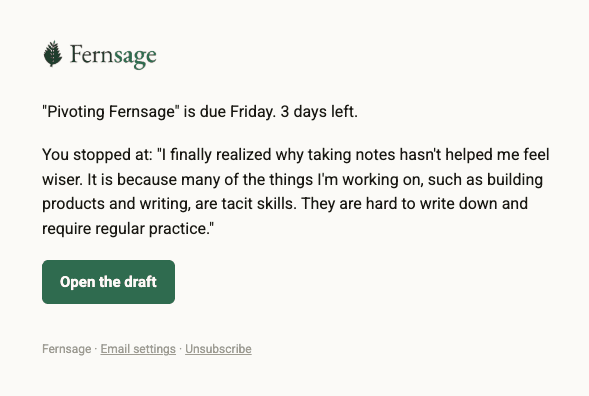
Honestly, I don't know yet if this is what writers need. (If you keep putting off your drafts, try it for free and tell me whether it actually gets you to write!)
But I know I need to keep getting my reps in. Maybe this doesn't work out. Then I'll build another product. And another one. And another one.
Got a draft you keep putting off?Pick the day you'll publish it, and Fernsage keeps you to it.
Finish it with Fernsage