2026 · 07 · 31
Write a book of your own thinking

Hello readers!
Today, I'm launching a new business:
Fernsage, an app for keeping a public commonplace book to help you think and learn better.
I created Fernsage because private notetaking apps felt like a graveyard of forgotten ideas while public blogging felt too messy and ephemeral. Fernsage is my take on compounding wisdom over a lifetime. Starting with my own life: https://alfred.fernsage.com/
Let me tell you what Fernsage is, why I made it, and what you can use it for:
- Wisdom grown in the shade
- Five years in the making
- From Marcus Aurelius to me
Wisdom grown in the shade
Why “Fernsage”? It is a compound word. Fern, the ancient plant that thrives quietly in the shade. Sage, a wise person. I wanted a name that evokes someone who steps away from the noise of social media to cultivate timeless wisdom in the quiet.
Fernsage the software is built for that: Write down things that inspire you, in a structured manner, and refine them until you internalize them. Your commonplace book is a deliberate collection that grows more useful the more you use it.
And, yes, using Fernsage feels intentionally deliberate. When I sat down to design it, my principle was: Reading the pages should be easy; editing should be intentional.
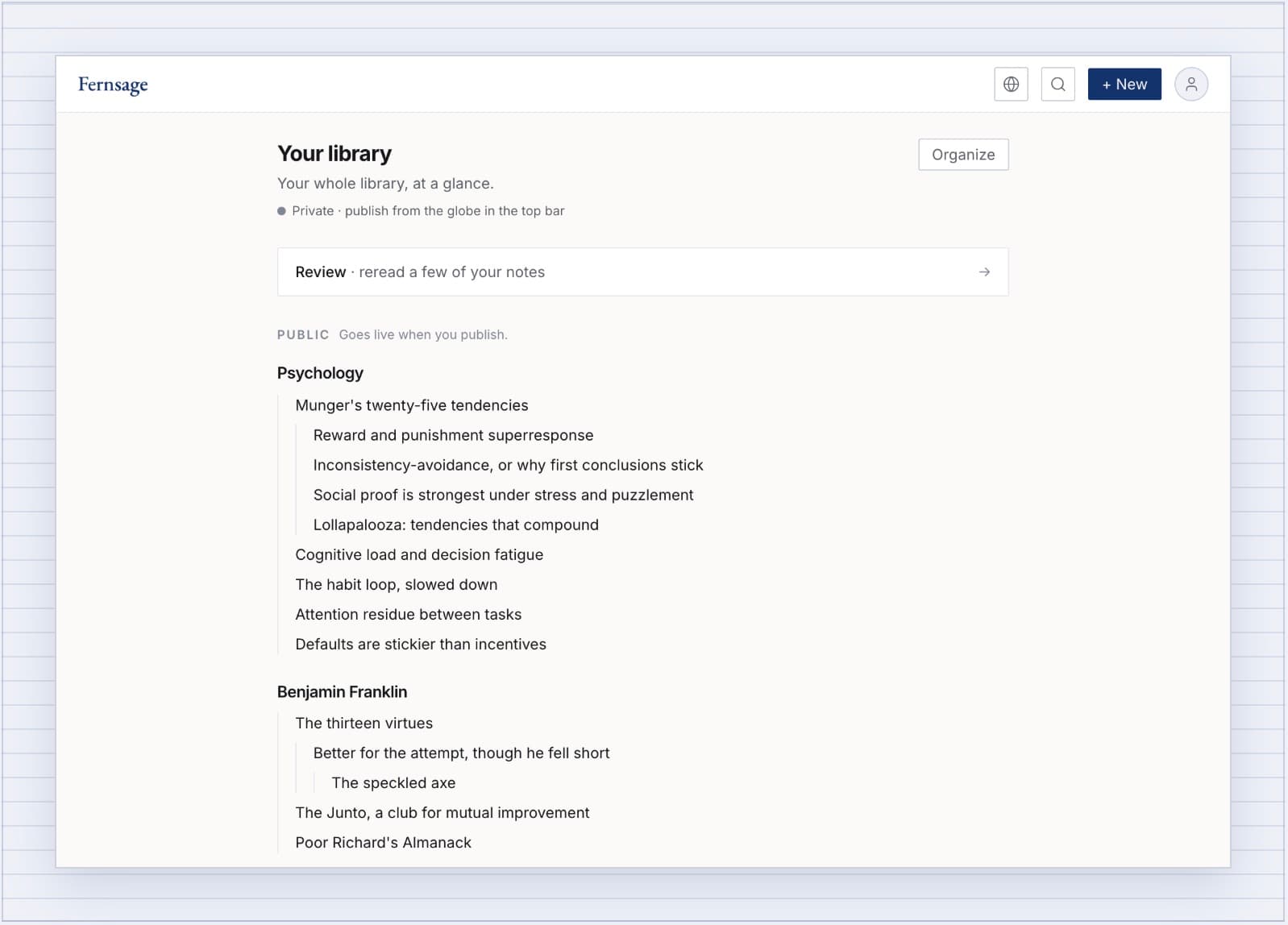
Just like the content page of a book, your Fernsage home is an organized list of pages like this:
Reading a single page looks like this:
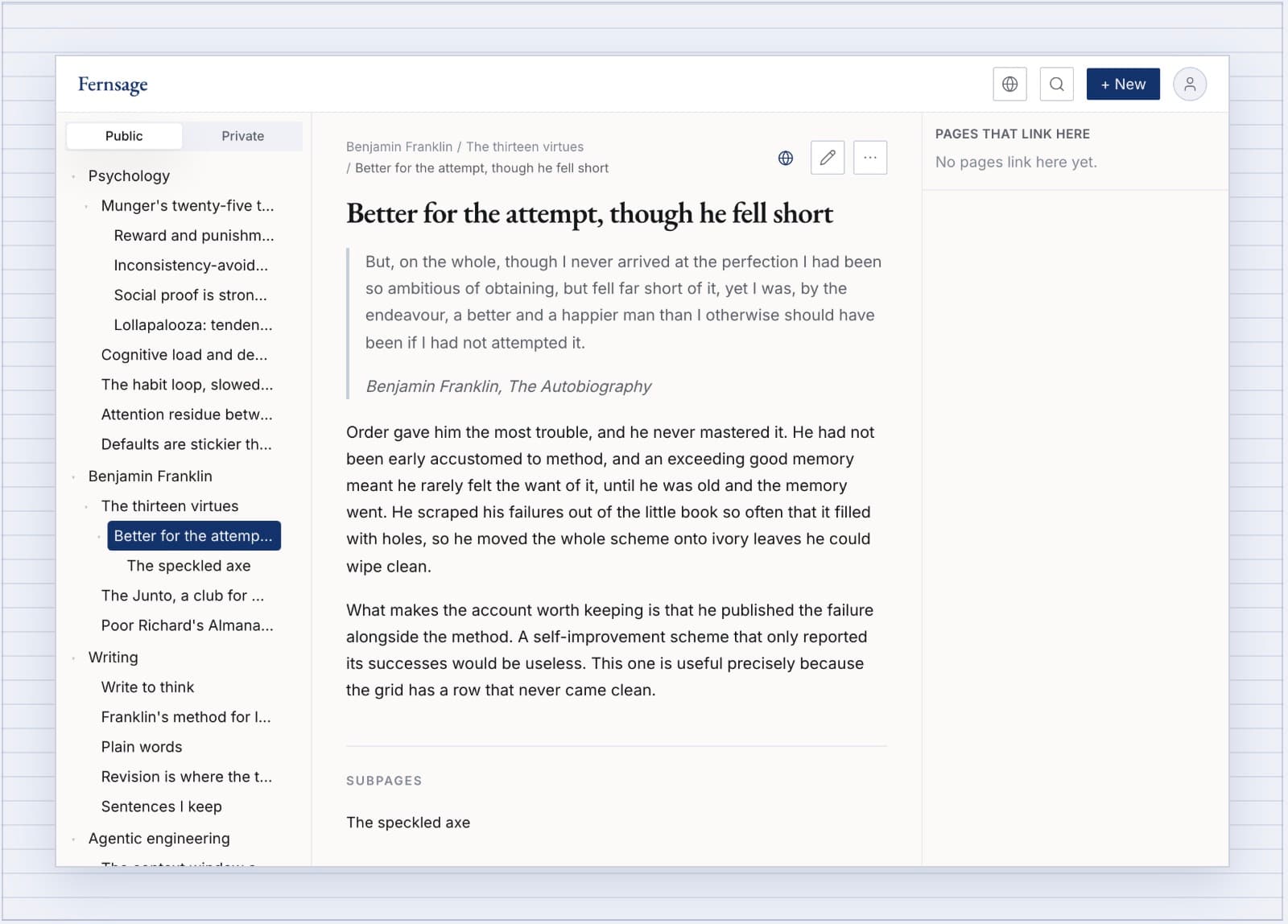
Want to edit a page? Click "Edit" first. Want to rearrange your pages? Click "Organize" first. Traditional notetaking apps feel too easy to edit, too fluid, too light.
Whether you revisit your notes is technically up to you. But I wanted to be opinionated about it. So, I baked Review into Fernsage. Click it anytime, and get five entries that you haven't visited lately. This has nudged me to revise and update my older notes, and even merge and delete some.
Oh, and I HAVE to tell you to install Fernsage as an app on your smartphone. Tap "Share", then "Add to Home Screen". I spent many days crafting and tweaking the mobile experience because I use it on my iPhone multiple times a day.
Want to write your book? $10 a month, 14 days free. There isn't a free tier. Subscriptions are the whole of the business, and the simplest way to keep this going forever. A tool to hold decades of your thinking has to last as long.
Five years in the making
Here’s something personal: I have been feeling rather stupid.
It has been a decade since I graduated from university and stepped into the "real world". I have built and marketed software, founded startups, and become a parent. Even though I have been through quite a bit and learned a lot, I found myself retaining very little. Which, honestly, sucks. Starting from (almost) zero all the time is ridiculous. I want my knowledge to compound.
I used to think: Oh, if it's important, I'll remember it. Some stuff, I do. But a lot, I forget. Then, I thought: I can just google or ask ChatGPT. Seneca wrote about a lazy Roman who bought educated slaves to prompt him with poetry quotes so he could sound wise at dinner parties. Seneca wrote of him:
a man whose reliance on slaves is so complete that he cannot even think for himself. He has bought slaves and has had them trained to memorize poetry, so that he can be cultured while having nothing in his head.
Ouch! Using Google and ChatGPT sometimes feels like this. I can ask ChatGPT to translate a Japanese sentence but that doesn't help me converse in Japanese. I can google for Anna Quindlen's A Short Guide to a Happy Life anytime I want but that doesn’t help me embrace life fully. (Typing it out does.) Having the information is not the same as knowing, understanding, and acting on it.
Perhaps I just needed to be taking notes? Over the years, I tried Evernote, Notion, and Obsidian. Even as my notes pile up, I felt none the wiser. What I found is that these apps are great scratchpads (I'm writing this draft on Obsidian) but not for accumulating knowledge.
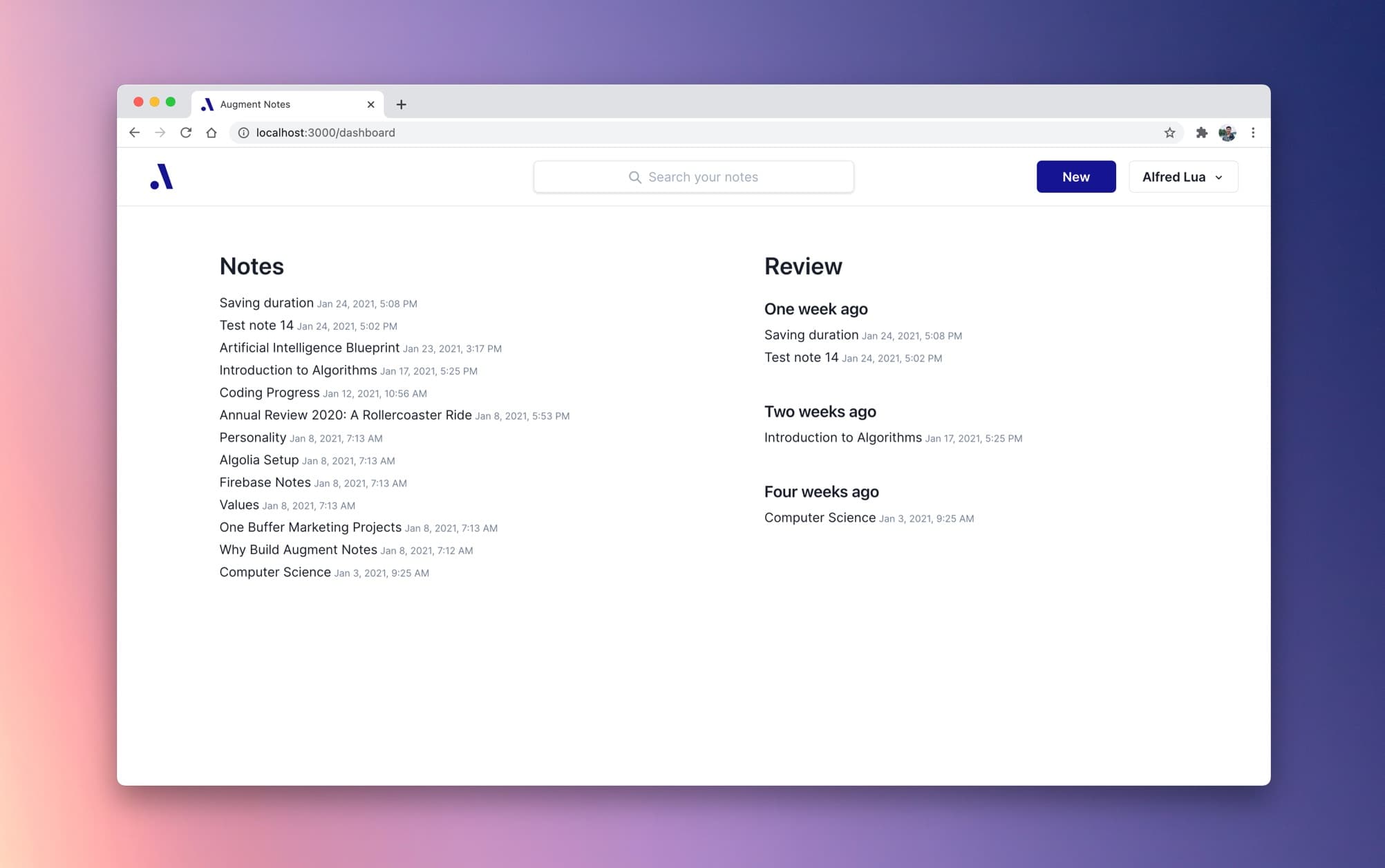
I first attempted to solve this problem for myself five years ago. Not only did I start a physical notebook business, I also built Augment Notes, a notes app to augment my memory. (Both failed.)
Earlier this year, when taking a break, I had the space and time to ponder what to work on next. After becoming a parent, I have been thinking more about learning and how we pass down knowledge. Then, this commonplace book idea popped up. The stars aligned. Building something I'm passionate about that can also help me become a better person? Oh, elegant. I'm in!
As a software lover and builder, I began my quest for a solution. Five years of endless iterations in Figma and countless ‘not good enoughs’ from SK have sharpened my instinct for software. All that eventually led me to Fernsage, and this email to you.
From Marcus Aurelius to me
Marcus Aurelius quoted and paraphrased other thinkers like Socrates and Epictetus according to his current challenges so that he could be inspired to act with virtue. Ryan Holiday reads widely, writes down his notes on 4x6 ruled index cards, and organizes them in a physical box, which he then uses for his writing and talks. Austin Kleon stores quotes in an Apple Note and hand-copies selected ones, one a day, into a 5-year diary. History is filled with famous thinkers who kept such a practice: Ralph Waldo Emerson, Charles Darwin, John Locke, Thomas Jefferson, Mark Twain.
There isn't a "correct" way to keep a commonplace book. Your book is… yours! The ways I use mine were inspired by the giants before me but adapted to my very ordinary life:
- Whenever I come across something interesting about topics I care about (parenting, AI coding, human behavior), I copy it and add a quick personal note. I usually add to an existing page so that I can keep refining my notes, unless nothing is suitable.
- When I make a mistake or learn something new, such as dealing with caching for a publishing platform or adding hidden features in an app, I write down what I learned.
- I also record things that I actually want to refer to in the future, such as house renovation lessons and cooking recipes. Some of these, I keep private, of course.
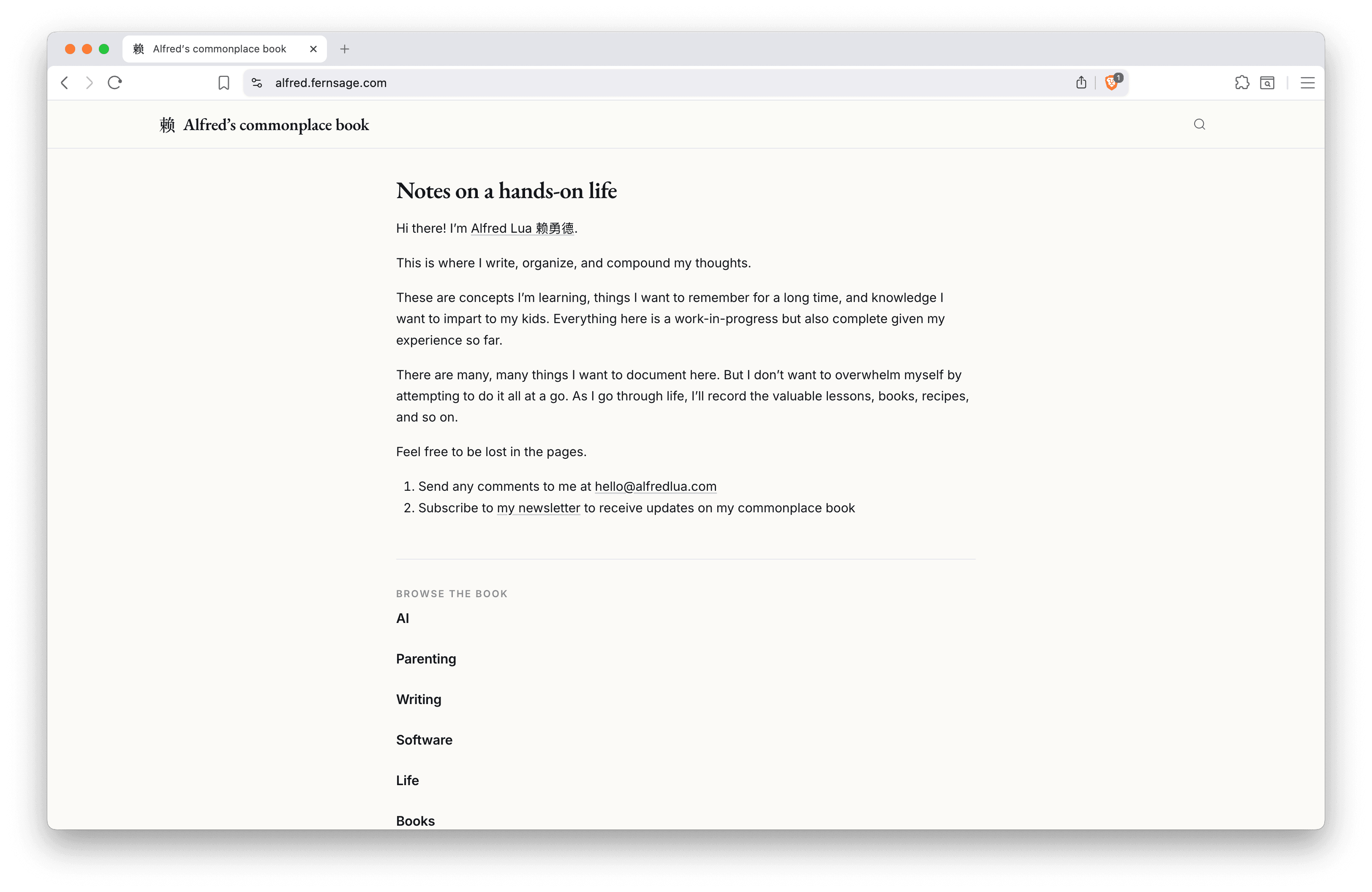
I don't record everything in my commonplace book. Recording everything just because I might use them in the future is what created my graveyard of notes that I actually don't touch. I curate. I hand pick. I prune.
But why publish my commonplace book? It is a forcing function. I write differently when I know someone will be reading. You probably do, too. When taking private notes, we can afford to be sloppy. But when writing for others, we hold ourselves to a higher standard, to think and write clearly. "It’s by writing about a subject we’re trying to learn that we reason our way to what it means," wrote William Zinsser. And if we are wrong on the internet, someone will correct us. It's like free peer review!
*Cue XKCD*

If you do create a commonplace book on Fernsage and leave your book open, send me your link. I’d love to read your thinking, and feature a few favorite books on the website.
From my commonplace book
I have been working slowly through Michel de Montaigne's On the Education of Children, with the help of Gemini because I'm not used to 16th-century prose. There's so much to learn. It's definitely something I want to revisit again and again.
I bought Analects: With Selections from Traditional Commentaries in 2015 as a Kindle book and recently bought a physical copy so that I can flip back and forth between pages more easily. I haven't been able to work through it as much as I'd like but here are my three favorite chapters from my reread so far. I just added 1.1 this week:
子曰:「學而時習之,不亦說乎?有朋自遠方來,不亦樂乎?人不知而不慍,不亦君子乎?」
The Master said, "To learn and then have occasion to practice what you have learned — is this not satisfying? To have friends arrive from afar — is this not a joy? To be patient even when others do not understand — is this not the mark of the gentleman?"
I have been reading David Epstein's new book, which is finally out on Libby. Wanting to share this page actually forced me to scroll through my highlights and update my notes. The process is working!
Around the web
Keeping to the theme, this week's links are all about commonplacing.
Letter 84: On Gathering Ideas by Seneca (and commentary by Stephen)
we should imitate the bees: we should sift through whatever we have gathered from various reading sources (for things kept separately are better preserved), and then, applying the care and skill of our own mind, blend those various tastes into one combined flavor.
Montaigne, quite aptly, borrowed Seneca's metaphor in his essay, On the Education of Children:
Bees cull their several sweets from this flower and that blossom, here and there where they find them, but themselves afterward make the honey, which is all and purely their own, and no more thyme and marjoram: so the several fragments he borrows from others, he will transform and shuffle together to compile a work that shall be absolutely his own; that is to say, his judgment: his instruction, labor and study, tend to nothing else but to form that.
Re-Noted: Ralph Waldo Emerson's "Wide World" by Jillian Hess
Make your own Bible. Select & Collect all those words & sentences that in all your reading have been to you like the blast of a trumpet out of Shakespear [sic], Seneca, Moses, John, & Paul.
Emerson also believed that, when we know someone would read what we write, we become self-conscious and write differently. He thought that is bad if we wrote to seek approval. "A man's speech is shallow, himself is shallow, who speaks or writes to satisfy an audience."
How And Why To Keep A “Commonplace Book” by Ryan Holiday
I have always been inspired by how much knowledge (or quotes) Ryan Holiday has. This article is from 2014(!), which shows how timeless his approach is, but the practice goes way back to Ancient Greece and Rome.
I have been delaying this launch so that I could keep polishing the app and website (and partially because I was and still am nervous about a lukewarm response). But reading Inside the Box prodded me to draw a line in the sand and launch before July ends. This is my last July newsletter and my final opportunity to launch Fernsage. So, thank you for reading along and giving me the push I needed.
Take a look around, and let me know what you think!
Warmly
Alfred
Want to come back to this later?Keep it in your digital commonplace book.
Save to FernsageRecent newsletters
- 2026·10·23
- 2026·10·16